Welcome back, let’s dive a little deeper into earthquakes.
The vast majority of earthquakes on Earth come from two or more plate edges roughly rubbing together. Their edges get stuck because of friction. Even though they’re stuck, the plates keep trying to move because the forces inside the Earth keep pushing or pulling. This builds up stress on the plate edge, kind of like pulling on a rubber band or bending a stick. Eventually, the stress becomes too strong and the plates suddenly slip. That is the shaking we feel as an earthquake. Each year the Earth has on average about 125,000 quakes with a magnitude of 3.0 and higher.
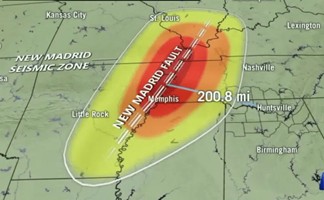
In addition to plate boundaries earthquakes also occur along faults, or cracks in rock layers where movement occurs. Some of these faults are tiny only showing up on the most detailed maps, while others are huge fault zones. A famous fault zone, relatively close to us here in central KY is the New Madrid Seismic Zone (NMSZ). It is made up of several smaller faults like the Reelfoot, Axial and New Madrid faults all of which are buried several hundred feet in the ground.
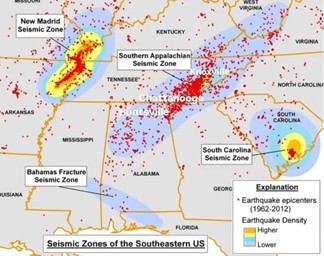 According to the USGS there are some other smaller faults as well, but the ones listed here are the most active. This seismic zone touches at least part of 7 states. According to the Arkansas Division of Emergency Management the NMSZ has generated ground movements in Arkansas, Missouri, Illinois, Indiana, Kentucky, Tennessee, and Mississippi. They go on to say that there is a 7 to 10 percent chance that this area will generate an earthquake of magnitude 7 in the next 50 years. I sure hope not.
In all honesty, we are just as likely to feel shaking from one of the many other tiny faults as we are the New Madrid or the Southern Appalachian Seismic Zone (SASZ). On the map at left the tiny red dots in central Kentucky are on the tiny local faults. This map shows not only seismic zones but also the earthquakes. It is courtesy of the North Georgia Weather page.
Historically, the largest magnitude earthquake I can find on the SASZ is a 5.0. Depending on its epicenter that could be felt here in central Kentucky but would be far from devastating.
The following information is coming directly from my brain, and from my educational background as an Earth Scientist, so I don’t have any links to back it up. However, I will list some at the end if you want to go digging deeper. In the last few years, data and stored information has become harder and harder to find, or I have just gotten older and forgot where most of it was stored.
So what is our real chance to experience an earthquake right here where we live? Let me break it down for you. Locally Kentucky’s strongest modern quake was a magnitude 5.2 near Maysville in 1980, it was widely felt, all the way to the Eastern tip of Pike county, but it was not catastrophic. I was just a wizard’s apprentice at that time, and had not reached my teens yet but I remember it distinctly shaking the house.
No this quake was NOT on any of the seismic zones, neither have any of the ones felt here in the last 10 years been on the seismic zones. Just like the SASZ these small quakes nearby are rarely ever going to be larger than 5.0. It is just so rare for them to be any larger. But that being said, a magnitude 3.0 to 4.0 is almost a certainty in the next 2 years, because they are so common. Magnitude 5.0 is a distinct possibility in the next 10 years. Magnitude 6.0 likelihood is not zero but it is small for central Kentucky. A magnitude 6.0 likelihood is about 25 percent in the next 50 years. It would almost certainly originate on the New Madrid Fault. A magnitude 7.0 likelihood, 7 to 10 percent chance in the next 50 years.
Central Kentucky will keep feeling small, routine quakes, while larger events remain possible but uncommon. Our risk is real yet manageable: frequent mild tremors, occasional moderate shaking, and only a slim chance of a major New Madrid event. Staying informed—and prepared—remains our smartest path forward.
https://fayettelepc.com/earthquakes/
https://www.earthquakenearme.com/en/blog/fault-lines/new-madrid-fault
https://www.ready.gov/earthquakes
About the Author