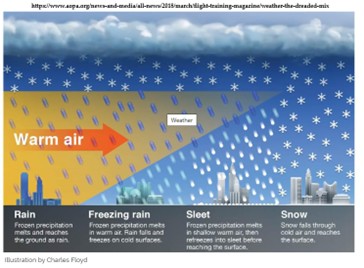
I have tried to remember events from my childhood that were historically important in the frozen water category, namely sleet, freezing rain, and graupel. To be quite honest I couldn’t remember any ice events, but could remember HUGE snow events. I lived a sheltered childhood, well as much shelter as living between two 4,000 foot high mountains could give. I remember all kinds of snow storms, but those are for another story. For this one we are going to focus on three distinct forms of winter ice. Each one of them is “shaped” by tiny differences in atmospheric temperature layers. Understanding them is crucial for safety, since they affect roads, power lines, and our lives in very different ways.
First let’s look at the atmospheric conditions that lead to each of them. Sleet: Requires a thin warm layer aloft and a deep freezing layer near the surface. The snowflake melts slightly, then refreezes into pellets before reaching the ground.
Freezing Rain: Occurs when there is a deep or thick warm layer aloft and only a thin freezing layer at the surface. The tiny drops remain liquid until impact, then instantly freeze on EVERYTHING.
Graupel: Forms entirely within clouds, when supercooled droplets coat snowflakes, creating soft squishy, rounded pellets. Unlike sleet, graupel doesn’t involve melting/refreezing during descent, they are actually soft pellets.
In central Kentucky and the Red River Gorge area sleet and freezing rain are common during winter storms because warm air from the south often “noses in” over Arctic air at the surface. Graupel, however, forms in and falls from the clouds through Arctic air.
The effects of each of these types are all different in their own right. For sleet, expect slick roads as it accumulates, but it is manageable and can be driven on slowly, cleanup is the same as snow, plows and salt. Graupel is easy, treat it like snow; it is usually brief and often harmless, but can be mistaken for hail, honestly, more of a curiosity than a hazard. Freezing rain is in a league of its own. By far the most devastating and dangerous type of winter precipitation. Planning and preparation is key. Be prepared for extended power outages with lines down and poles snapped off due to extreme weight. Tree limbs or trees downed is common, roads will often become impassable with debris and extremely slick conditions. Ice Storms in Kentucky are made from this nightmare. If temperatures remain near the freezing point, 32 degrees fahrenheit then salt and scraping will work, however, if temperatures are low, like this past week, then clean up can be nearly impossible. Generators, portable power stations, alternate heat sources, food, medicines and other supplies are vital.
Here in Kentucky, we have devastation from this January 24 – 25, ice storm. Much of the state has been shut down Monday and Tuesday, with over 70,000 Kentuckians without electricity. According to Governor Beshear, many counties were hard hit but Pulaski County: Had the highest number of power outages early in the storm, with over 11,000 customers affected on Sunday morning. Furthermore, Allen County suffered severe damage, with officials stating it could take up to 10 days to restore power, noting it was worse than the historic 1994 ice storm. According to WKYT, power crews are fighting very hazardous conditions, from ice covered treacherous roads to downed trees and powerlines. They are replacing poles and equipment as fast as possible, but for many it will be days before the power is restored.
Our thoughts and prayers are with everyone affected by this massive winter storm. I will dive deeper into the states that were hit the worst and take a quick look at the historical ice storms of the past and just a little more in the next part of “The Making Of An Ice Storm”.
Winter weather in Kentucky has a way of reminding us that not all frozen precipitation is created equal. Even if our childhood memories tend to lean more toward the deep fun snows, more than slick ice, the events of January 24–25 show how quickly our landscape can shift from picturesque to perilous. We need a basic understanding of how each type forms in order to be able to combat its effects here on the surface. This knowledge gives us a roadmap for preparation, resilience, and looking out for one another when the weight of ice brings daily life to a halt. As Kentucky continues to recover from this latest storm, the lesson is clear: knowledge, readiness, and community remain our strongest defenses against the next big freeze.
About the Author